Week 13
Digital - Games and Game Design in Education
Play Based Learning
- The link between games and learning in not a contemporary phenomenon, nor a digital one.
Play Based Learning
- The link between games and learning in not a contemporary phenomenon, nor a digital one.
Game thinking
Marczewski (2016) explores the following types of game thinking:
- Game inspired design: This is where no actual elements from games are used, just ideas such as user interfaces that mimic those from games, design or artwork that is inspired by games or the way things are written.
- Gamification: Extrinsic gamification is the sort that most people are used to, where game elements are added to a system. Things like points, badges, progress bars etc.Intrinsic gamification is more about using motivation and behavioural design to engage users.
- Serious games: These may be teaching/learning games that teach you something using real gameplay, simulators that provide a virtual version of something from the real world that allows safe practice and testing, meaningful games that use gameplay to promote a meaningful message to the player, or purposeful games that create direct real world outcomes.
- Play (games / toys): Play is free form and has no extrinsically imposed goals. It is done for fun or joy. Games add defined goals and rules to play (such as challenges). Toys are objects that can be used in play or games.
A number of tools have been developed bor mobile devices that support game-like learning experiences linked to exploring outdoor environments
They include such features as
- competing individuals/teams
- treasure hunt style act
 ivities
 - scores/badges

ActionBound - Game
Gamification
Gamification is a concept, which is not exclusive of education. Some researchers generically defined it as “the use of game design elements and game mechanics in non-game contexts” This broad definition has been further refined to reflect the most common objective of gamification: increase user experience and engagement with a system. It is important to note that Games and Gamification are two different things! (Deterding, Dixon, Khaled & Nacke, 2011).
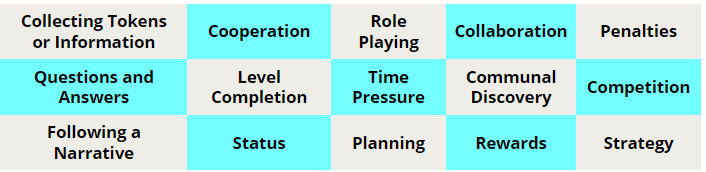
Do the games have aspects of these?
GAME LAYER
Gamifying Mindfulness
“If the greatest mission of positive psychology is to enhance global flourishing, the potential of smartphone-based interventions may play a vital role.” (Howells, A., Ivtzan, I., & Eiroa-Orosa, F. J. 2014).
Mindfulness apps are trending in a big way. The success of apps like ‘Stop, Breathe & Think’ and ‘Headspace’ coincides with the steady rise of mindfulness culture as science continues to prove the myriad mental and physical benefits of the ancient practice.
“Gamification strategies require the addition of systemic game mechanics and features into tasks or other content we would normally consider a game in order to positively influence behaviors and motivations within users.” (Choo, A., & May, A. 2014).
Professional Leadership Games
Gamification has been applied to leadership in some organisations One example is the NTT Data Ignite Leadership Game that addresses five key skills for leaders
- negotiation
- communication
- time management
- change management
- problem solving
Deloitte's Leadership Learning Motivator includes sharing badges on professional networks such as LinkedIn and Twitter. Meister (2013) provides some more detail on both games, while Bodnar (2014) explores some of the key concepts in more depth, including some discussion around whether the same motivational game mechanics work across cultures.
Seven Principles of Game-based Design
These principles are outlined on the Quest to Learn website (Quest To Learn, n.d.)
- Everyone is a participant
- Challenge
- Learning happens by doing
- Feedback is immediate and ongoing
- Failure is reframed as “iteration”
- Everything is interconnected
- It kind of feels like play
Gamify your Practice
LEVEL UP!
See these documents from the in class activity for ideas on how you could gamify your practice:
- “Quest to Learn 7 principles of game-based design” to improve meaningful collaboration at tinyurl.com/TML7principles
- “10 Strategies To Design Your Classroom Like A Video Game” from the article at tinyurl.com/designlikeagame
- Seth Priebatsch’s 4 Game Mechanics Video BUILDING A GAME LAYER
10 Strategies To Design Your Classroom Like A Video Game
1. Realize self-directed learning not by merely suggesting it, but making it necessary to get anything done.
2. Design learning experiences so that students see visible progress on a daily basis.
3. Make objectives clear, and offer students multiple ways to accomplish them.
4. Give students the tools to design and build what you hadn’t thought of.
5. Design with iteration in mind: one skill builds on the next, and students need it all to succeed.
6. Use project-based learning where students design the entire process from brainstorming to publishing.
7. Give students malleable learning tools and resources that they can customize, or “upgrade” to fit their approach to learning.
8. Make learning both collaborative and competitive.
9. Consider challenge-based learning and place-based education, where students solve problems important to them, in communities that are watching.
10. Gamify your classroom in a way that focuses not on standards, data, or “proficiency,” but personal progress meaningful to the student.
Comments
Post a Comment